

Review all prior CELH research and portfolio changes on the TSOH website
From “Celsius: A Global Opportunity?” (published June 2025): “While their relationship hasn’t always been perfect, Coca-Cola and Monster have generally worked towards the same long-term objectives. It’s less clear to me that will be true for PepsiCo and Celsius, particularly outside of the United States. What I find disheartening about this is that there’s a pretty clear opportunity for a more cohesive strategy: between Rockstar, Sting, and Celsius / Alani Nu, you’d have a collection of brands to serve a broad range of energy drink consumers, in terms of age and gender, as well as value and premium brands (similar to Monster’s Strategic Brands). Instead, they are set to compete with each other as they each look to build their global presence.”
In an industry with a seemingly endless barrage of new entrants over the past two decades, Celsius has managed to achieve the impressive feat of building a portfolio that captures about 20% of the U.S. energy drink market – and with it, they’ve become a real competitor to behemoths Red Bull and Monster.
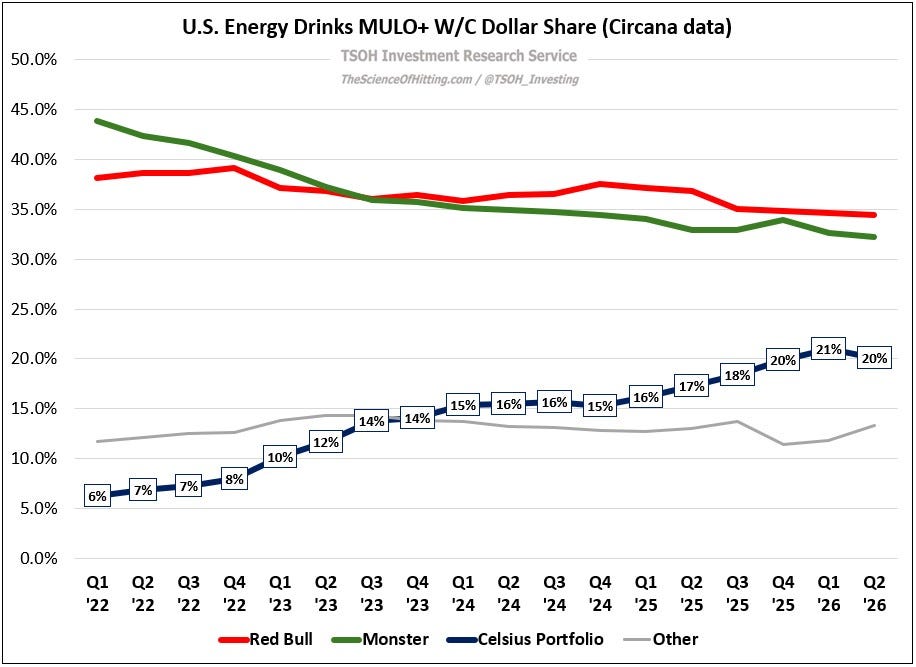
This was achieved with one hand tied behind their back: only competing in sugar free, which accounts for about half of the ~$29 billion U.S. energy drink retail market (put differently, they account for ~40% of the ~$15 billion sugar free subcategory). It is a uniquely positioned brand competing well against the sugar free varieties from Red Bull and Monster, while fending off direct (more narrow) competition from energy drink brands like Bang and Reign.
A straightforward strategy that was focused on expanding the Celsius brand throughout the U.S. and around the world was then muddied by the ~$1.65 billion Alani acquisition. As I explained, I was of two minds about that deal: