

Note: Review 5+ years of NFLX research and trades on the TSOH website
From “Netflix: This Is When It All Matters” (April 2022): “A key part of any long-term investment is partnering with an honest and able management team; while this period is a major bump in the road, I’m confident that Netflix management will adjust and find a way to win in the years ahead.”
That update was published following Netflix’s Q1 FY22 results, at a time when sequential subscriber growth had come to a standstill. For a company that led structural change in the media industry over the prior 10+ years, this presented previously unexperienced financial pressures, with revenue growth falling below 10% in each of the next six quarters. It coincided with profit headwinds, as TTM operating margins contracted more than 400 basis points over the next two years. The stock, which traded at ~$60 per share at the end of 2021, was below $20 per share six months later (split adjusted). Netflix was a first mover in DTC streaming, but legacy media companies had responded – and Mr. Market was convinced tougher times were coming.
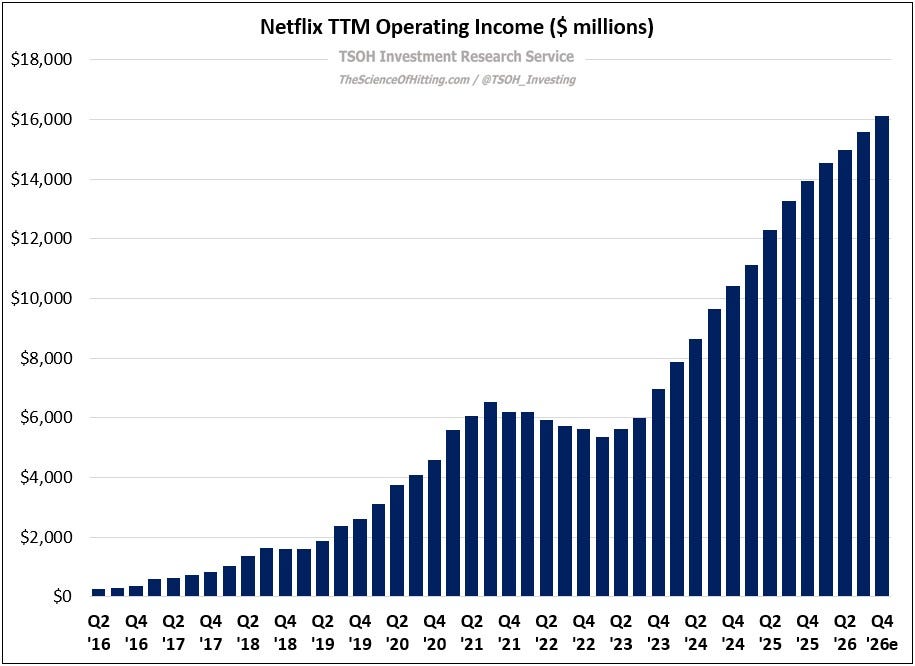
That pessimistic take proved well overstated, as reflected in various KPIs. A notable example is operating income, which has compounded at >20% over the past five years, to ~$16.1 billion in FY26e. (At ~$66 per share, or an EV of ~$285 billion, Netflix is trading at a mid-teens NTM EV/EBIT multiple.)
Another is revenue growth, which returned to the double-digits in Q4 FY23 and has remained there ever since. That period was undoubtedly a tough one for Netflix – but management responded and proved the naysayers wrong. Those with the ability to see beyond near term challenges were ultimately well rewarded, with a trough to peak stock price increase of >7x off the lows.
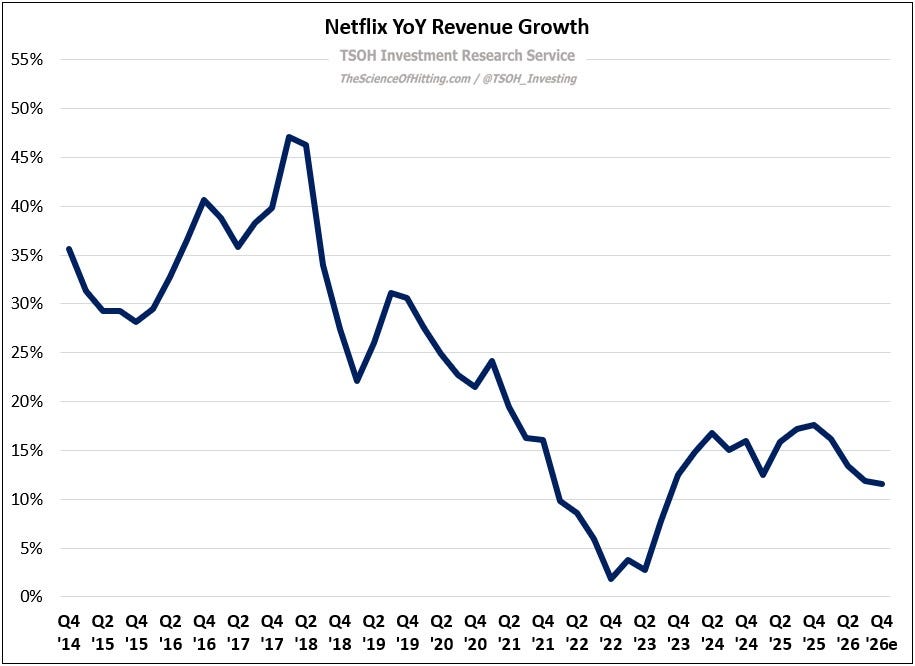
While the above revenue chart provides some relative context for the following statement (i.e. what we’re seeing today doesn’t rival 2H FY22), there’s a clear sense that Netflix is facing another period of heightened competitive intensity. That viewpoint has been exacerbated by their uncharacteristic decision to pursue a >$80 billion acquisition, along with struggles in the near term to reaccelerate engagement trends. More recently, they announced layoffs affecting ~6% of their workforce, including their Chief Content Officer and the head of their film division. As management admits, current growth rates are falling short of what they aspire to. Some cracks have emerged in Netflix’s business, and they will need to be addressed.
That brings us to the opening comment from co-CEO Ted Sarandos during the Q&A session of the company’s Q3 FY26 earnings call. When pressed on an evolution in Netflix’s strategy, he said the following:
“Our strategy is unchanged. It always has been, and it continues to be, to combine best-in-class entertainment with industry-leading discovery, global distribution, and the best possible monetization. We want to be the must-have entertainment service, the first one members check for a great series or film and the last service they’d ever canceled. The anchor of that strategy are Netflix originals. Differentiated, exclusive, ambitious, professionally produced series, films, and live events. We’ve oriented the market to expect something great and new to watch every week, so we have to always deliver on quality and quantity. Live events… drive new membership, they add fuel to our ad revenues, they please our existing members, and they enhance the value of Netflix… We pair exclusive programming with a broad offering of third-party programming, including second run titles… In addition, we look to new ways to bring third-party content onto the service, like we just did with TF1 in France, where we ingest a full network of programming… Roughly 95% of our spend and nearly all of our revenue is focused on that core, where we see a long runway for growth… The core is the critical growth engine.”
Sarandos can be a bit hardheaded about how it’s labeled (“unchanged”), but that’s beside the point. What’s become clear - and importantly what I think management also now recognizes - is that Netflix needs to make changes on the margin to more effectively execute against its long-standing strategy.
Own The Core
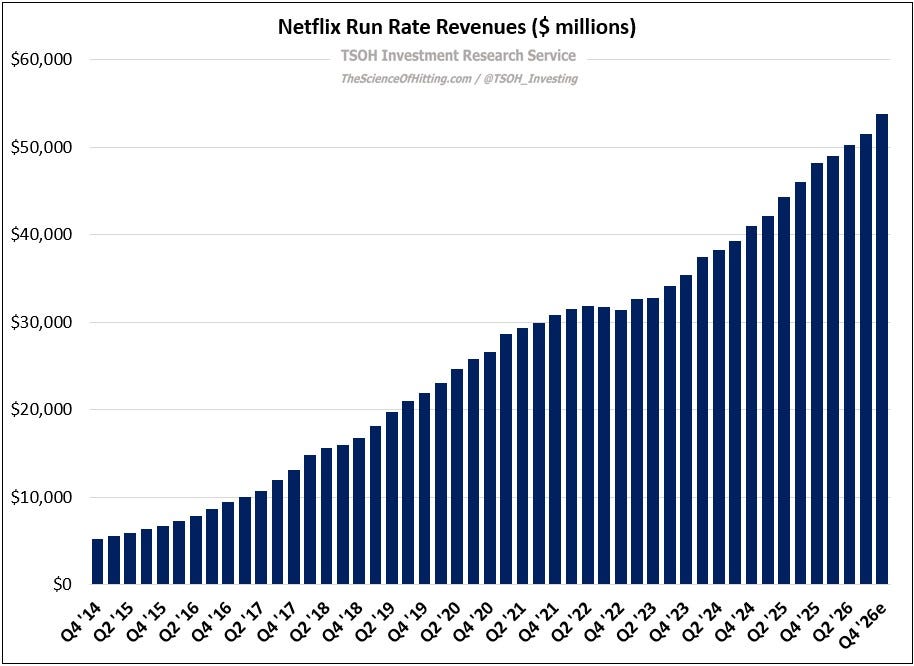
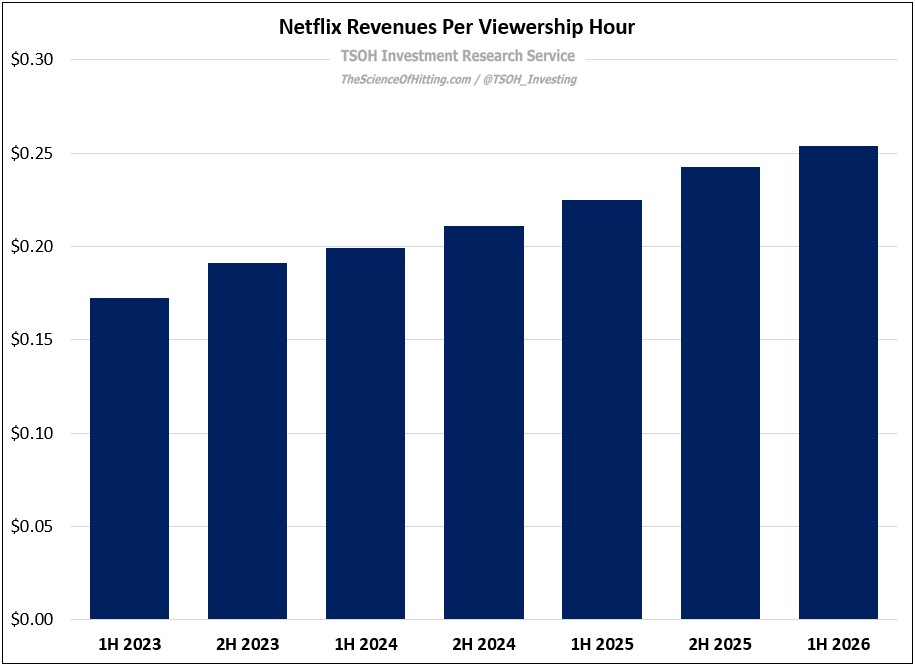
Despite persistent effort by the legacy media companies over the past 5+ years to try and close the gap, Netflix has sustained a massive global scale advantage. The company is on track for FY26e revenues of >$51 billion, which is roughly equal to the combined global DTC revenues generated by Disney, HBO Max, Paramount+, and Peacock. After years of significant investment, they all remain distant competitors to Netflix – less so in the U.S., but crucially in terms of global scale. (A reminder that Netflix generates about 50 hours of monthly viewership per average global member household, from which they generate only ~$0.25 in revenue per global viewership hour.)
On the other hand, the entertainment industry is evolving, with rising adoption for newer formats like user-generated content and short-form video. While I believe Netflix is largely holding its own in the narrower market of traditional TV shows and movies (albeit with near term volatility in a hit-driven business), its position in these newer formats rounds to zero. The media industry is evolving – to the benefit of YouTube and Meta, and at the expense of Netflix.
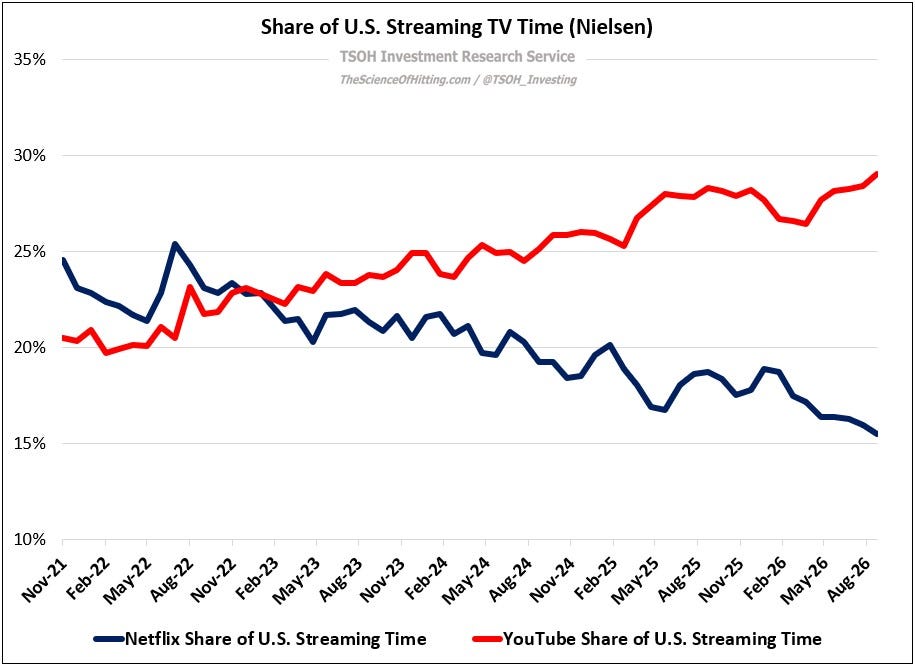
While I can appreciate efforts in video podcasts and with select YouTube creators, the critical priority for Netflix is to own their core opportunity: professionally produced movies and TV shows, documentaries, stand-up comedy, and live events. I don’t think the answer is to try and replicate YouTube. Instead, it’s to adjust their tactics to become a better Netflix.
One area where this has become clear is theatrical releases. Management has been somewhat resistant to industry-standard windowing – and on occasion, that has impacted the talent they could work with. First, I’d argue with the premise that a theatrical window materially diminishes the value of a movie on a streaming service (see “Project Hail Mary”, a nice winner for Amazon Prime Video after raking in nearly $700 million at the box office). Instead, I’d bet the opposite is true: movies with a theatrical run often have improved awareness and are viewed somewhat differently (being of higher quality) upon landing on a streaming service. But even if Netflix management still disagrees, I think we’re past the point where that matters: for top talent, they need to acquiesce on this issue. I suspect incoming Chief Content Officer Peter Rice will push for this to change, and it’s an important one. (“We need better execution [on our U.S. content]… We had some solid doubles and triples - but other territories count on some of those U.S. titles being home runs so they travel around the world. We’re focusing on execution.”)
Another example is a more traditional release schedule for their “highest-quality” TV shows, à la certain HBO shows; again, I think there’s a certain level of awareness and perception improvement associated with this model (as opposed to dropping an entire season at once). These adjustments can improve Netflix’s relationship with talent and its perceived value / quality among viewers; these are changes that management now seems open to.
In addition to those tweaks on Netflix originals, I was encouraged by two of the content licensing deals announced this quarter (with Disney and Globo). This is more of Netflix’s bread-and-butter, and it’s an area that has been in some flux over the years depending on the level of commitment that the various media companies have made to DTC at points in time. I continue to believe that this is a sustainable source of important supply, either through licensing or a more significant commitment (M&A). Effective execution here, which is rooted in the sustainable competitive advantages of industry leading scale and global reach, remains critical to Netflix’s long-term success.
Beyond these factors, I think the severity of Netflix’s current business challenges have started to be overstated. The stock getting cut in half from the mid-2025 highs has as much to do with the more optimistic assumptions the valuation implied / required as it does with anything in management’s near-term control. Mr. Market was optimistic, and now he’s somewhat less so.
Admittedly, Netflix cannot pull (to the same degree) some of the key levers that they did in 2022, most notably the password sharing crackdown and the ad-supported (AVOD) tier. At the same time, this business will report FY26e revenue and EBIT growth of ~13% and ~22%, respectively. Netflix continues to operate from a position of strength, and it does so with a large TAM ahead; with effective execution, I think the stock will generate solid returns from here.
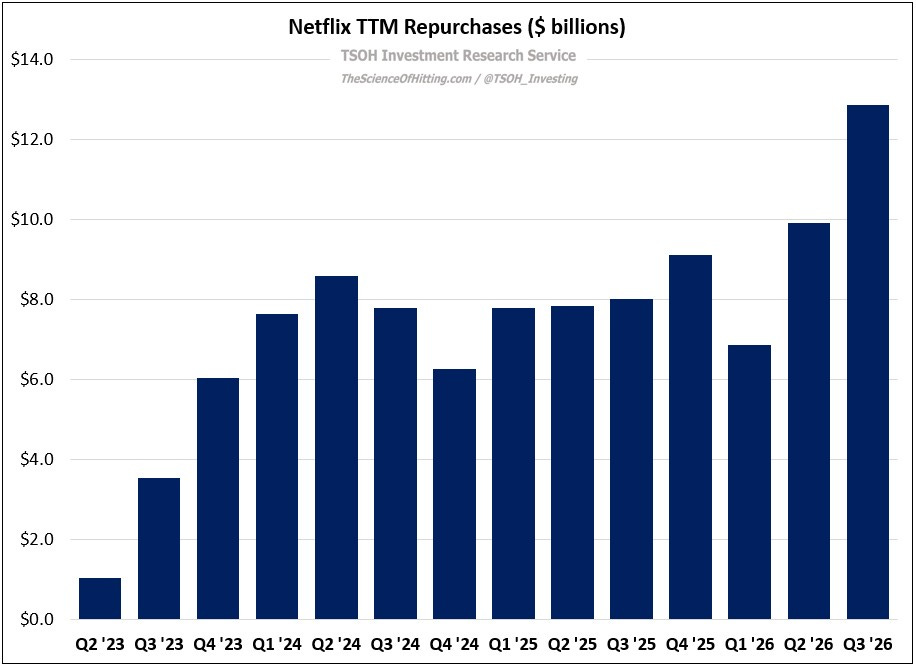
Management’s actions suggest they agree: the company repurchased a record $4.8 billion of stock during the third quarter (at an average cost of ~$75 per share), bringing the trailing 12-month tally to ~$12.9 billion. As a result, Netflix’s diluted share count has declined by >3% over the past year.
Conclusion
The below graphic details all of my Netflix trades since I first bought the stock in January 2022. While I naturally wish that I would have bought more aggressively in mid-to-late 2022, and trimmed / sold more aggressively in mid-2025, I’ve done an effective job to date of not being overly influenced by Mr. Market’s wildly changing views on Netflix over the past five years. As a result, I’ve generated attractive returns on this investment, at least thus far.