

From “Dollar General: From Bad To Worse” (September 2023):
“As I see it, the bear case for Dollar General is best explained by examining Walmart’s results since Doug McMillon became CEO [in 2014]. Over the past decade, the company has invested to sharpen its price points, to improve the cleanliness and efficiency of its U.S. stores, and to build out e-commerce (omnichannel) solutions like pick-up / delivery that can more effectively compete with DG’s value proposition (said differently, better positioned to compete for certain purchase decisions that they may have been losing to DG previously). While I think these investments were clearly the right ones for Walmart over the long-term, their sustained impact is still evident in today’s P&L: Walmart U.S. FY23 EBIT margins are still well below FY13 levels. I think a discouraging outcome for Dollar General investors could take a similar shape: an extended period of margin compression from a combination of price investments and rising costs… If this materializes, I think it is not insignificant to consider what that would ultimately mean for Family Dollar.”
As I wrote in June, Q1 FY24 seemed like a notable step in the right direction for Dollar General; not only did they close the comp gap with Walmart U.S., but they also took another step ahead of Family Dollar. That was only the first move towards an improvement in their financials, with plenty of work left to do on profitability / margins, but it was an important step nonetheless (especially so given Dollar Tree’s announcement on impending Family Dollar changes).
Then DG’s Q2 FY24 results took all of the air out of that balloon.
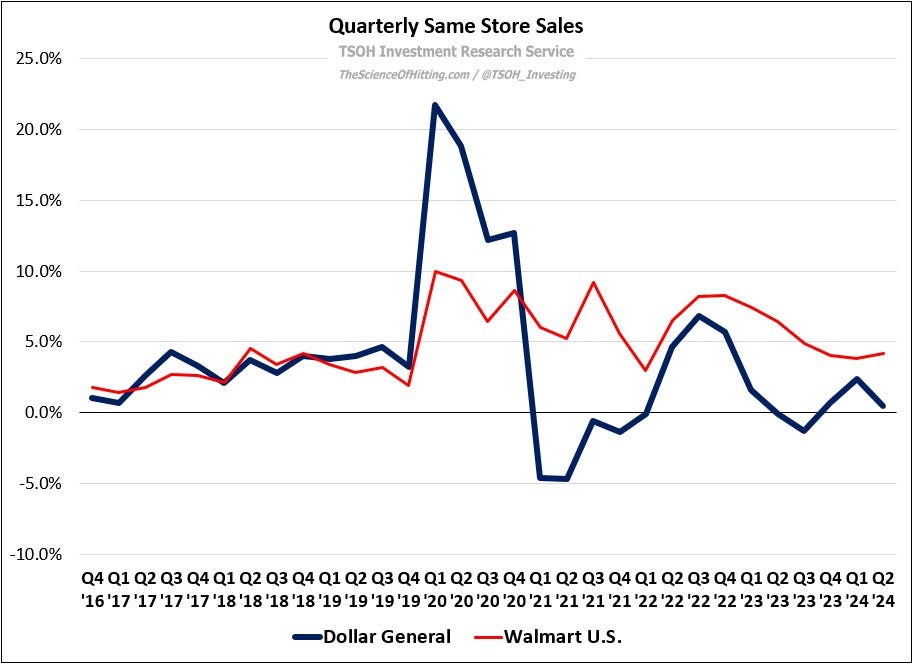
First, DG reported weak comps in the second quarter (+0.5%), which fell short of the results at Walmart U.S. by a wide margin (+4.2%). As you can see below, this marks the continuation of a tough run for Dollar General: they’ve lagged the Walmart U.S. comps for 14 consecutive quarters.
On Walmart’s Q2 FY25 call, I found this comment from McMillon noteworthy: “We had another good quarter with strong sales growth and even stronger profit growth. The team not only drove our short-term results, but they also continued to drive change. Their good work is resulting in customers not only saving money on an increasingly broad assortment, but also saving time. Convenience matters, and we are uniquely positioned to provide it.”
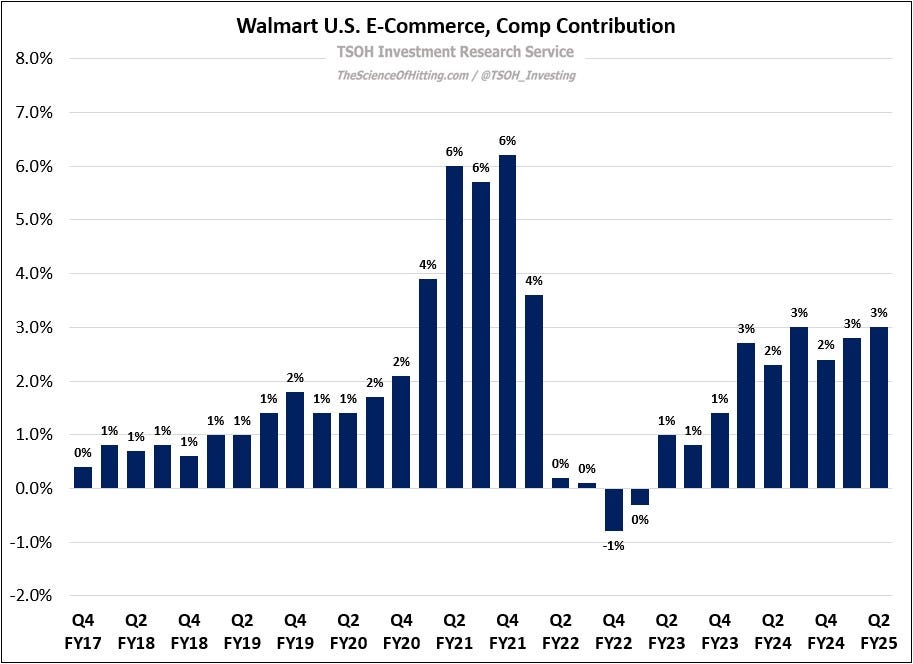
Convenience comes in various forms, but one notable example is Walmart’s omnichannel offerings, most notably delivery and BOPIS (buy online, pickup in store / in the Walmart parking lot). Before focusing on what this means for DG specifically, consider the following data: Walmart’s e-commerce business has been contributing 200 - 300 basis points to their quarterly comps over the past 12-18 months. To put that contribution in context, the Walmart U.S. business struggled to consistently report 3%+ consolidated comps in the years before the pandemic. I think the most logical interpretation of this data is Walmart is winning incremental sales dollars that used to go elsewhere.
That brings us back to DG. On the Q2 FY24 call, CEO Todd Vasos said the following: “What we did see in Q2, which was different than Q1, is of the available share to take, we didn’t get our fair share of that… In Q2, the mass channel, and especially those guys down south, did a lot better gaining the share available in the marketplace… The guys in Bentonville are doing a pretty nice job in garnering the available traffic from other retailers.”
He expounded on that point in a later answer: “What we’ve noticed is the trade-in [from higher income cohorts than DG’s core customer] has been slower to come in to the channel than what we had anticipated and have seen in the past… The middle and the upper middle income are still looking for value… The other thing that we've noticed is more and more online activity comes from that cohort. Our core customer continues her online journey pretty much the way she was; it's pretty static. But we’ve noticed that middle to upper middle continues to rely on online a little bit more. So, as that occurs, I believe the trade-in slows a little bit on that side.”
My interpretation of the above aligns with my earlier concerns: DG is losing some trips (on the margin) that they previously could have or would have won, with Walmart as the likely beneficiary. Newer services like Walmart+ and Walmart+ Assist are providing value for customers; the problem for DG, as I see it, is that they can’t (effectively) compete with these new use cases. As I wrote in “Back To The Basics”, DG’s BOPIS experiment revealed some of the realities of running a store with only ~$2 million in sales and ~$600,000 in gross profits; the model is such that DG has to be selective on the role(s) it serves. Through that lens, you can see why there’s truth to McMillon’s view that Walmart is “uniquely positioned” to serve this customer value proposition. Retail is a highly competitive industry, and the bar continues rising over time.
On that topic, I think we need to answer a fundamental question: what value does DG provide to its customers? The primary answer, especially in the ~16,000 stores located in small towns (population of less than 20,000), is convenience. As a reminder, the majority of their products cost under $5, with an average transaction value around $16. (To put that into context, free delivery through Walmart+ is only available on $35+ orders.) The mix is also heavily weighted to consumables, which account for >80% of DG’s revenues.
Put differently, I think most Dollar General customers walk in the store to pick up a handful of products, with the need for (consumption of) those products likely to be in the immediate future. As we think about the competitive landscape and the threat from a company like Amazon, it’s critical to think about who DG’s customers are, what they’re buying, when they’re buying it (to use the product today, tomorrow, or next week), and the cost / value dynamics at play as a result of those variables. (DG’s Q2 FY24 call: “Our core customers, who contribute ~60% of our overall revenues, comes predominantly from households earning less than $35,000 annually.”)
As I think about that, I personally remain comfortable with the conclusion that DG is well positioned to serve the consumables value proposition as well as or better than a company like Amazon. (The other ~20% of DG’s mix is non-consumables. In that business, as discussed last quarter, I’m less confident in DG’s position. They have lost share and need to find an alternative solution.)
Again, it’s important to think about all of this in the context of Dollar General’s economic model. The company’s stores only generate ~$2 million AUV’s; by comparison, the average Walmart U.S. stores generates nearly $100 million a year (inclusive of e-commerce). Obviously their box sizes are very different, but the reality is that DG – at its current level of per store sales – must run with a much leaner OpEx model to survive. In recent years, the company has struggled to strike that balance (the pandemic certainly didn’t help); success requires well run, clean stores with fully stocked shelves and engaged associates. As a result of missing the mark, comp store sales have lagged, associate / manager turnover has increased, and other costs like shrink have remained stubbornly high. While the current pressures feel particularly acute, it is important to remember that this has always been the reality of DG’s economic model. They must improve on the factors within their control to ensure they do a better job meeting the needs of their core customer.
But importantly, I still think Walmart’s competitive threat is on the margin. If you imagine a range of DG use cases, with the left side being low dollar value / immediate use purchases and the right side being larger ticket stock-up trips, my perception is that Walmart omnichannel in particular, along with some other e-commerce players, can more effectively compete further to the left than they could a decade ago (and that is especially true for the cohort of potential DG customers outside their core). How can DG respond to these changing market dynamics? For one, DG has made (and needed to make) incremental labor investments, which can help to address certain operational challenges and improve the customer experience in their stores. Another potential opportunity is to lean harder into convenience and grocery, i.e. initiatives like DG Fresh. As they prioritize those items, I think management should reconsider the aggressiveness of unit growth targets, particularly at non-core banners like pOpshelf; now isn’t the time to divert their attention. Finally, as discussed in “The Road To Recovery”, major changes at Family Dollar - which strike me as increasingly likely under a new owner in light of today’s challenges - can be a substantial tailwind for thousands of DG stores.
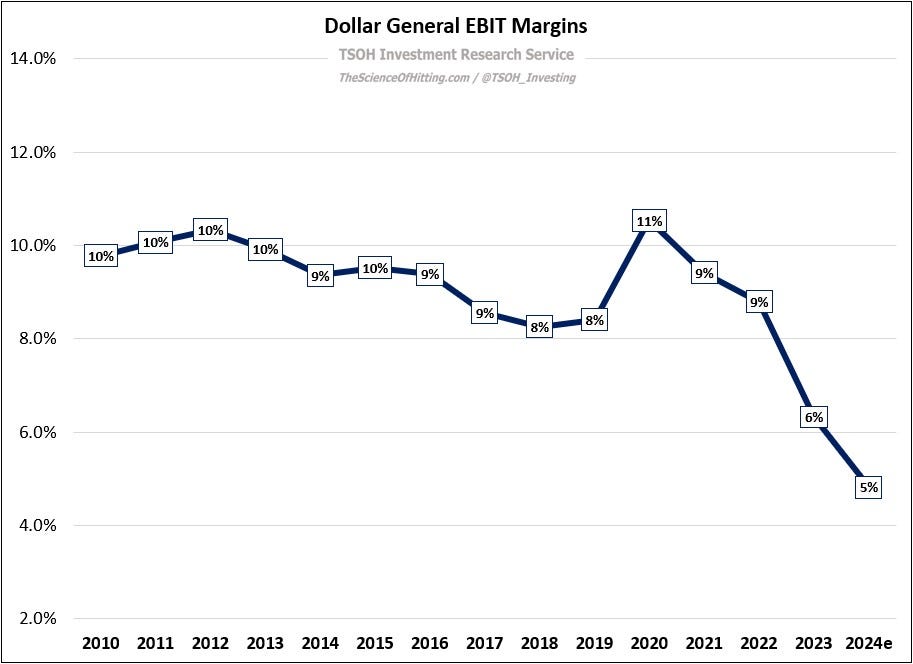
In summary, this was a difficult quarter. With FY24e operating margins of ~5%, DG’s financial model is clearly strained relative to its historical performance. While some changes are likely structural, we can roughly quantify their impact – for example, we can guesstimate that the headwind from consumables mix shift, all else equal, has been a cumulative 75 - 100 basis point gross margin drag. The question is if the other ~300 basis points are recoverable. My view is that at least half of that is recoverable, with the primary buckets being shrink, supply chain, and store costs that will lever with improved comps (this assumes a higher structural level of retail labor expense as a percentage of sales). If this proves accurate, there’s a path to ~7%+ EBIT margins over the next two or three years; if so, it is currently priced at less than 10x “normalized” EPS. (For what it’s worth, here’s CFO Kelly Dilts at the Goldman Sachs Retailing Conference: “We feel we've got the right to get back [to 2019 EBIT margins] over the next couple of years.”)
Dollar Tree
Much like at DG, Dollar Tree reported weak Q2 FY24 results. Also like DG, management pointed to the headwinds of a challenged consumer: “We are encouraged by the continuous progress we are making in the transformation underway at Dollar Tree and Family Dollar, despite immense pressures from a challenging macro environment… We are navigating through one of the most challenging macro environments we have ever seen.”
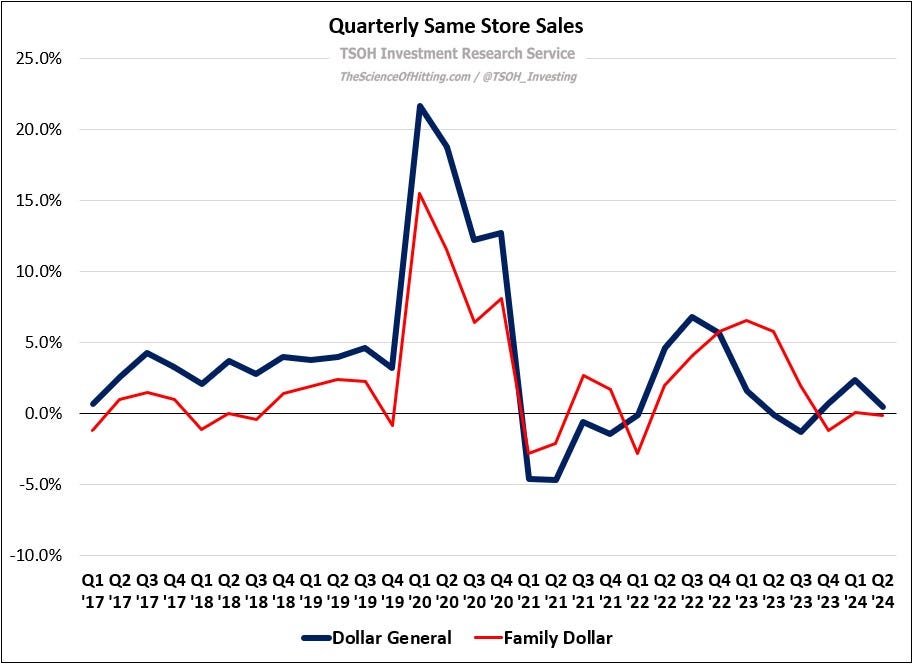
At Family Dollar, Q2 FY24 comps declined marginally (-0.1%), along with ongoing pressure on margins / profitability. I won’t spill too much ink here given that my views remain unchanged: the banner faces significant long-term challenges with few reasons to believe a turnaround is imminent. As it relates to the path forward, I think recent results provide further reason to believe that a potential buyer of FDO will act aggressively in terms of trying to generate a return on their investment; said differently, the pace of expected store closures in the years ahead is likely be much higher than a reasonable guess 12-18 months ago (particularly if FDO is sold to a financial buyer).
For now, we remain in limbo on FDO. With the environment becoming more difficult, my assumption is that the (already minimal) proceeds one may have expected from a sale has moved even lower. Personally, I think the more important consideration is to ensure they are squarely focused on the long-term opportunities at the namesake banner. Family Dollar has been a black eye at DLTR for a decade; they are right to accept reality and to move on.
That brings us to the Dollar Tree banner.
As shown below, comp trends have worsened, with management taking the FY24 comps guide from mid-single digit growth to low-single digit growth.
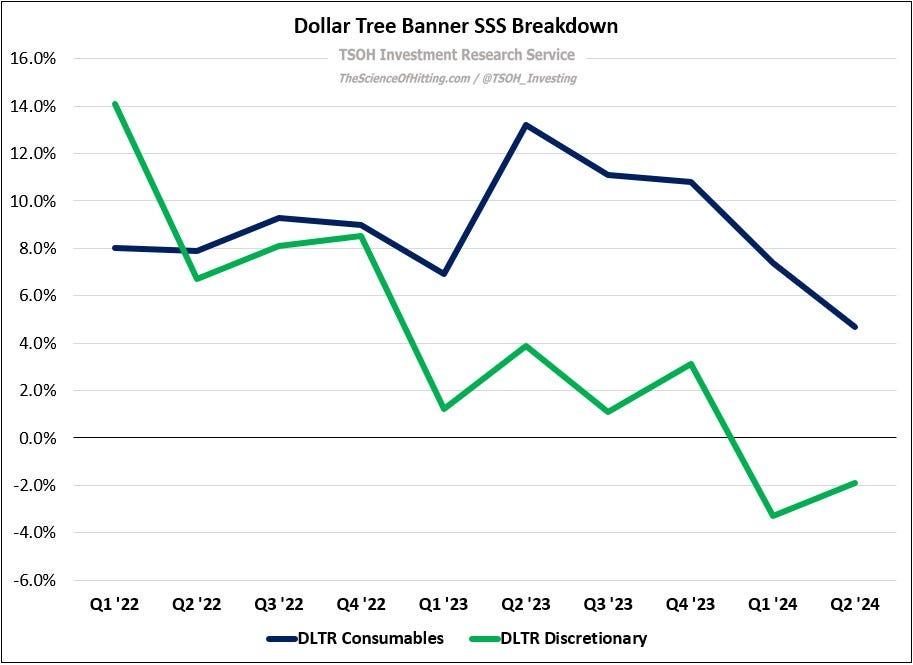
The optimistic takeaway is that the ~20% of Dollar Tree stores that have been reconfigured to their modern layout with the multi-price offerings are reporting strong results, with Q2 FY24 comps up nearly 5%. (To be clear, the multi-price assortment is available in the large majority of Dollar Tree stores; the metric cited above is the stores where the planogram has been changed to best display that merchandise.) That said, with total banner comps at +1.3% in Q2 FY24, that implies the remaining >6,000 stores (~80% of the pie) only reported marginally positive comps. In addition, the Q2 FY24 deck (slide 7) shows that their outperformance versus the market narrowed this quarter.
As with Dollar General, I think there’s only so much that can be said about the results at Dollar Tree in any given quarter, particularly when they appear abnormal relative to historic trends (in terms of insights that will help us to make a sensible long-term investment decision). My broader view on the business is informed by their strong historic results, my understanding of the role that they serve for their customer base (a group I’m part of), and how their long-term strategic transformative is likely to impact the business, meaning the risks and the opportunities that will arise from doing so.
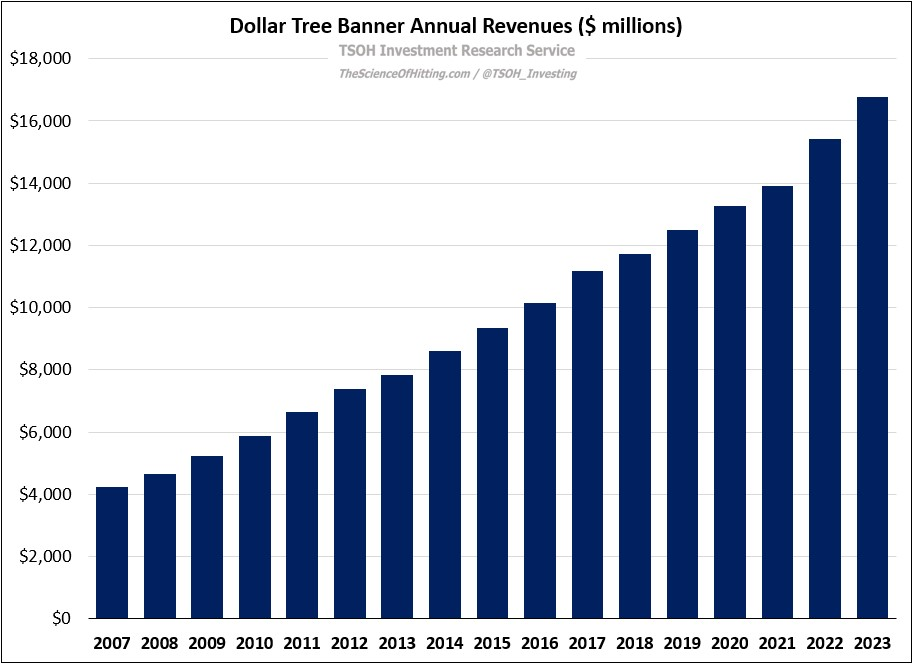
In the near term, Dollar Tree must navigate the challenges outlined in “Turning Point”. That includes finding an answer at Family Dollar, which remains a weight around the company’s neck. But once that happens, I think they have a clear path forward in the core banner. The combination of the low opening price point ($1.25) and the inclusion of some multi-price SKU’s (~15% of the product mix) presents the opportunity for a better customer experience and a better business. While it will lead to a somewhat broader competitive set, I think that will be a manageable change. This doesn’t negate today’s pressures, some of which are due to tougher macro conditions, but I remain of the view that this is the right long-term vision. Successful execution – replicating the Dollarama playbook – offers significant financial upside.
Some Historical Context
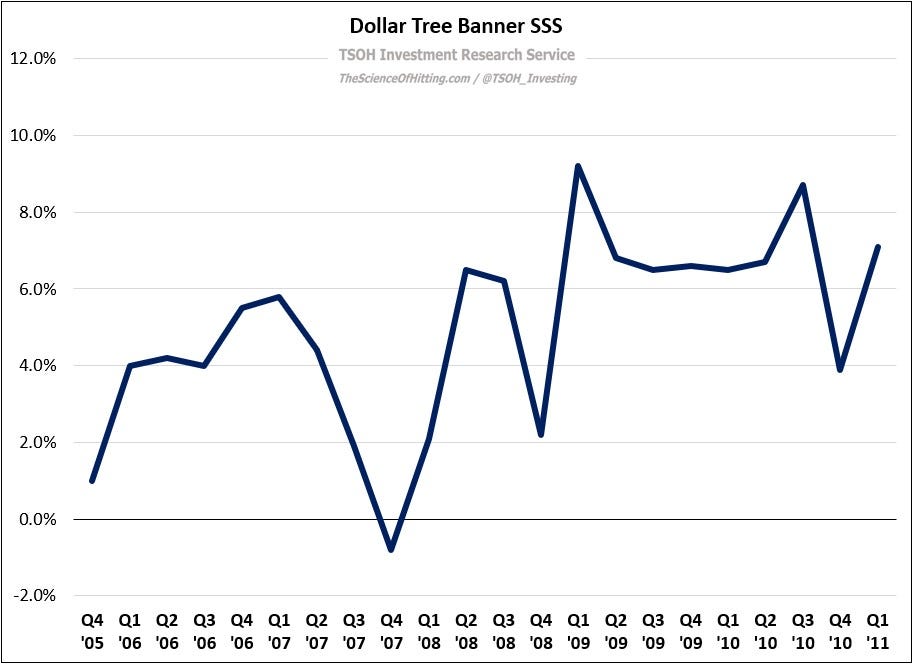
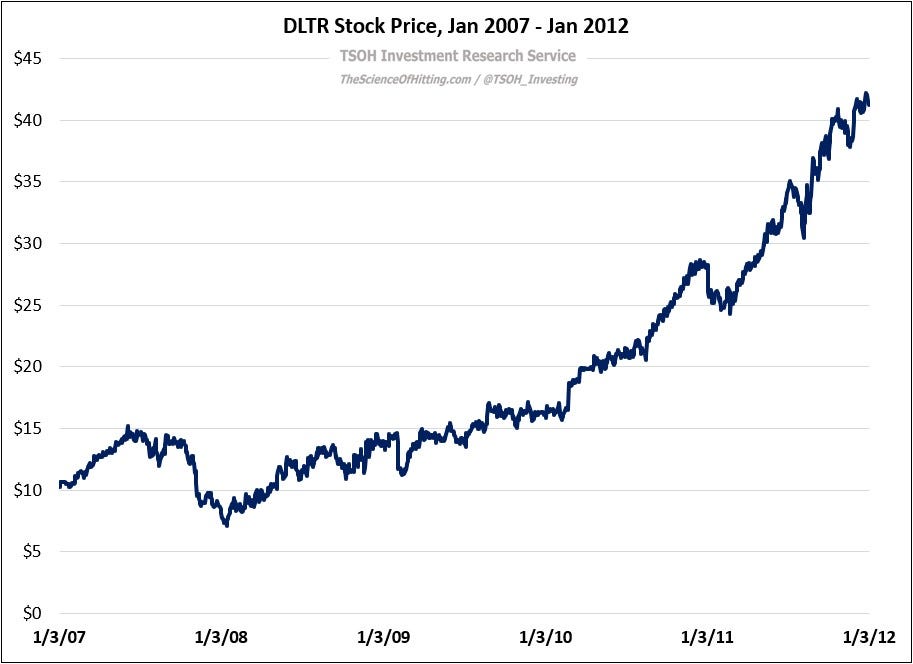
In February 2008, Dollar Tree reported its Q4 2007 results. Reported comps declined ~1%, a notable change in trend from prior periods. As CEO Bob Sasser noted at the time, the results reflected “continuing pressure on the consumer from a generally challenging economic environment”. Mr. Market wasn’t too pleased with that explanation: the stock, which had traded up to ~$15 per share in mid-2007, was down >50% by early 2008 (split adjusted).
But then the results started to improve. As you can see below, despite facing intensified macro pressures during the heart of the financial crisis, DLTR started reporting mid-single digit comps. That success was partly attributable to an improved assortment of consumer basics products and frozen / refrigerated products that customers could purchase at low price points.
The stock, which bottomed well below $10 per share in early 2008, was trading at ~$25 in early 2011. (As an aside, it’s interesting to note that DG’s comp trajectory during this period was quite similar: some weakness in late 2007 and early 2008 followed by stellar results for full year 2008 / 2009.)
In terms of drawing any conclusions today from what happened 15 years ago, particularly as it relates to how customers responded / acted then versus how they may respond / act now, all the usual caveats apply. My point in relaying this bit of history is to note that Dollar Tree (banner) and Dollar General have faced a somewhat similar situation before, i.e. a period where the results started to materially disappoint relative to prior expectations, and with management suggesting a key consideration was the impact being felt by their core consumer. At the time, I’d be willing to bet that analysts and investors questioned whether that answer fully explained what was going on, particularly given that a notable competitor like Walmart was still reporting solid results: “We had a very strong underlying operating performance, exceeding our expectations for the quarter… The price leadership strategy we put in place at the beginning of the year was exactly the right strategy… Price leadership and improved customer service made the difference.”
Again, we should always be careful about the conclusions drawn from prior experiences. Most notably, if you believe that the competitive environment has fundamentally changed, this example doesn’t hold water. Personally, and particularly for DLTR, I think it largely remains the same; as I see it, there are some interesting parallels between what they are seeing today and what they saw at that time.
Conclusion
In summary, this is undoubtedly a very difficult moment for DG and DLTR. We’ll see in the coming quarters and years whether the explanation of (largely) macro-driven weakness aligns with reality. Personally, as I think about the source of their potential long-term pressures, I am somewhat more worried about the long-term competitive dynamics faced by DG than at DLTR.
As a corollary, I continue to believe multi-price is the correct strategic pivot for Dollar Tree, which presents an opportunity to deliver a better customer shopping experience / command incremental wallet share and to improve the banner’s financial results over time. I can still imagine a scenario where I add additional DG shares, but DLTR strikes me as the higher priority for now.
On that last comment, a reminder that I view these as somewhat different businesses, with different competitive dynamics / exposures and long-term opportunities. To be specific, I do not believe that the long-term success or failure of Dollar Tree’s multi-price strategy shift will be highly correlated to the long-term success or failure of Dollar General’s business. I hope that gives you some context for how I think about these two stocks within a portfolio.
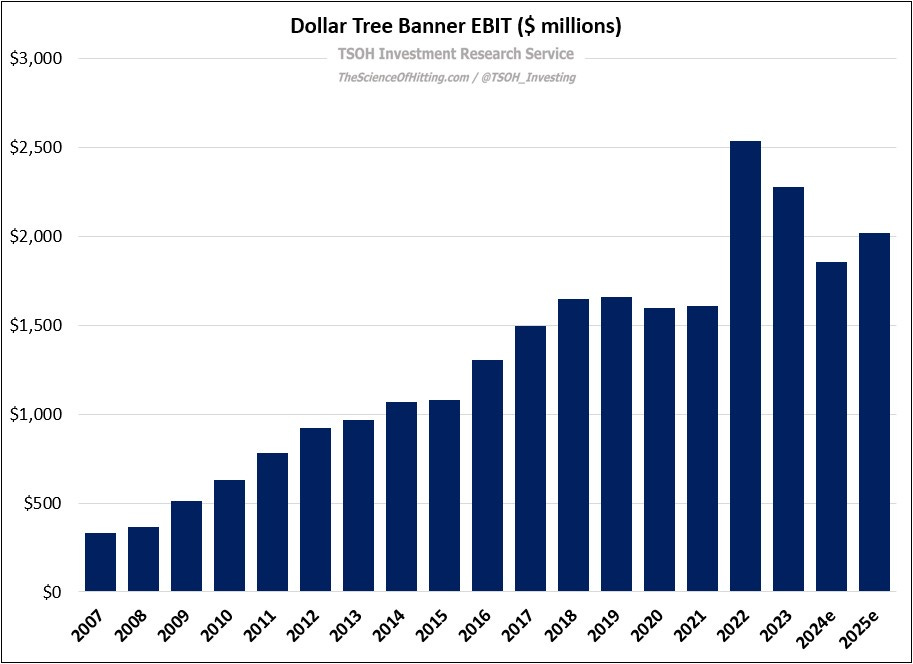
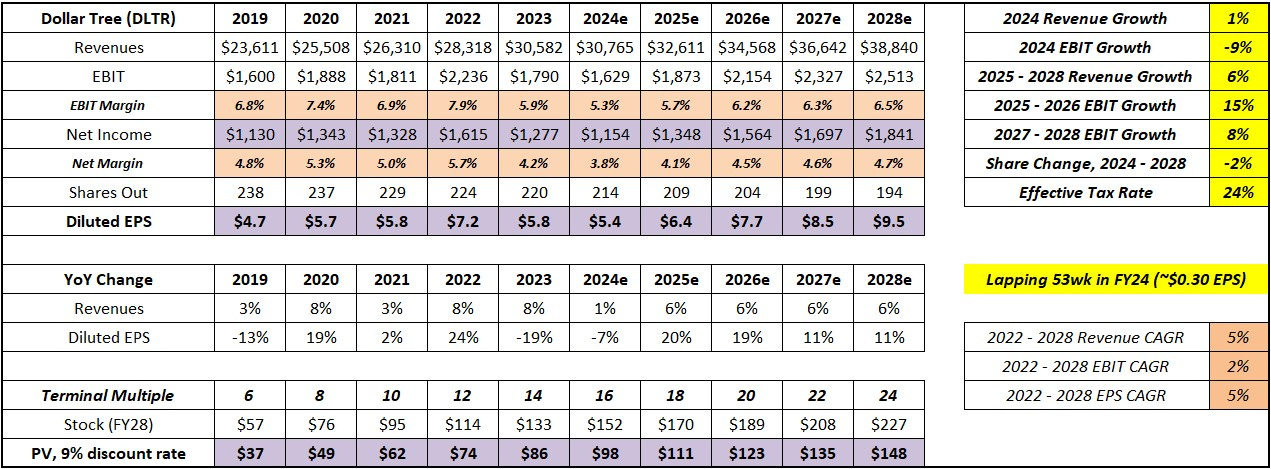
At ~$66 per share, Dollar Tree has a market cap of ~$14 billion. If we assume Family Dollar can be sold for ~$2 billion, I think that Mr. Market’s asking price for the core banner - less than 10x EV/EBIT - is simply too low. It surely isn’t too enjoyable to step right in front of a ~20% stock price decline, but that’s part of the game. I believed the stock was priced to generate attractive (long-term) returns at ~$85 per share, and that remains true at current prices.
In summary, I’ve decided to buy more Dollar Tree (DLTR). I will send an update after detailing the specific changes that will be executed in the TSOH portfolio.
NOTE - This is not investment advice. Do your own due diligence.
I make no representation, warranty, or undertaking, express or implied, as to the accuracy, reliability, completeness, or reasonableness of the information presented in this report. Assumptions, opinions, and estimates expressed in this report constitute my judgment as of the date thereof and are subject to change without notice. Projections are based on a number of assumptions, and there is no guarantee that they will be achieved. TSOH Investment Research is not acting as your advisor or in any fiduciary capacity.