

From “It’s Just The Beginning” (April 2021):
“Microsoft’s ability to find attractive growth opportunities is clearer today than it has been at any time since my initial investment in 2011. With strategic vision and execution, both of which Satya Nadella has delivered in spades since becoming CEO in 2014, the company should be able to sustain a level of [revenue and EPS] growth that seemed unfathomable a decade ago.”
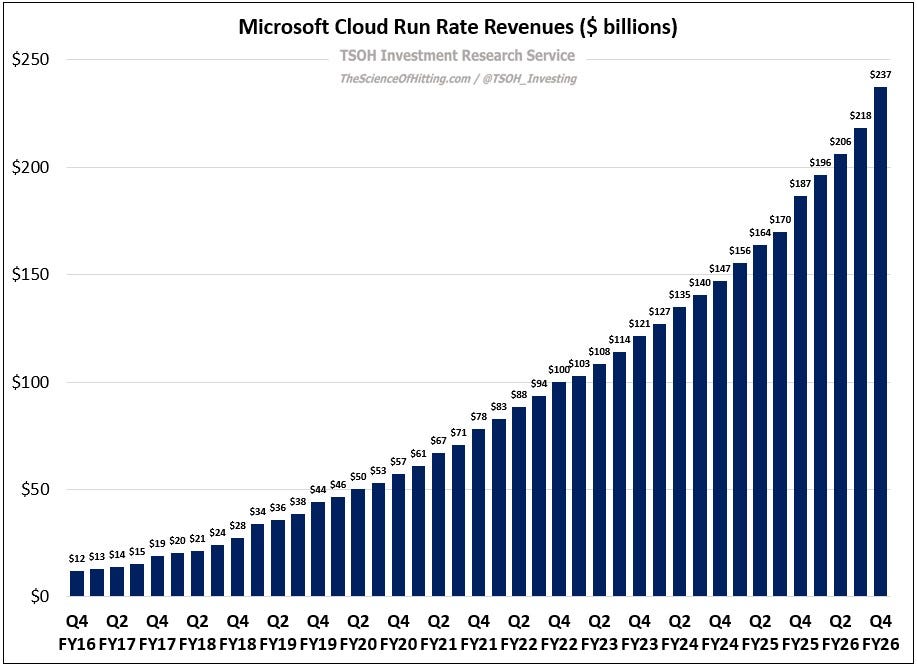
As Microsoft closed out FY16, the growing importance of the company’s Cloud business was on full display: while it had only recently surpassed 10% of their revenue base, it had grown ~50% over the prior year, to a run rate of $12 billion. While the company had already established a near-term goal for the Cloud business - $20 billion run rate revenues by FY18 – it was clear from CFO Amy Hood’s commentary that the Cloud vision was much larger than the results expected over the next 2-3 years: “The first thing Satya and I focus on is how much of our business are we continuing to shift to annuity and, specifically, to cloud. We structure all of our motions - how we engineer, how we do our go-to-market, how we think about sales engagement, and how we invest - fundamentally toward the long-term structural cloud transition.”
Microsoft surpassed that near-term goal goal for the Cloud business (>$20 billion run rate by YE FY18) and never looked back: the business grew at a ~35% annualized rate over the past decade, to ~$237 billion at YE FY26. An astounding decade for Microsoft’s business, with the stock compounding at a ~25% annualized rate over the past ten years, primarily reflected their leadership position in Cloud. (As discussed in “It’s Always About The People”, success for Microsoft was far from assured in the early 2010’s.)
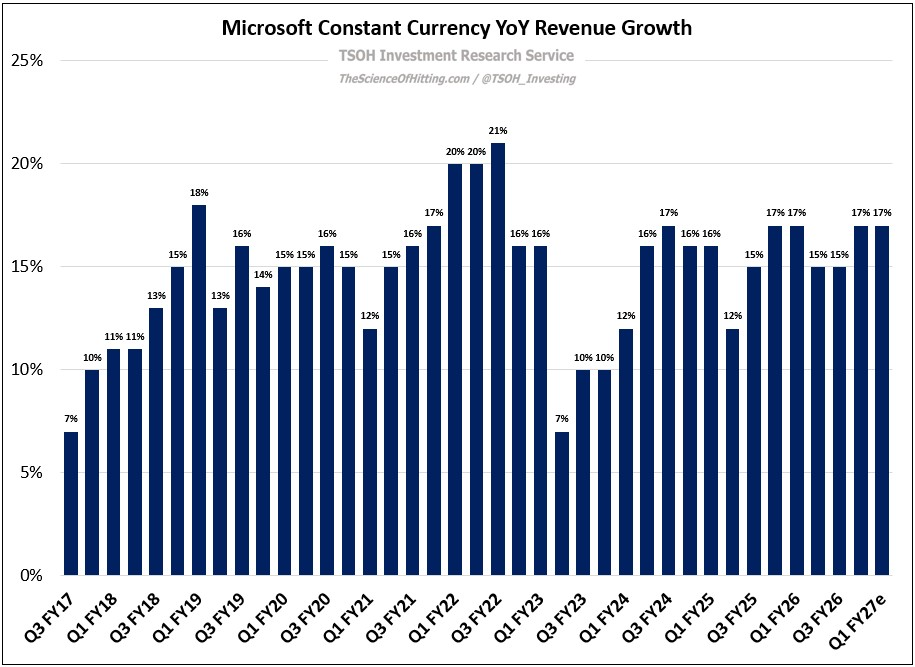
While Microsoft’s impressive top-line growth rates have been sustained in recent periods, with the company reporting double-digit constant currency revenue growth in each quarter for the past nine years except one, there’s been one notable difference of late: a significant CapEx ramp. (For more on this topic, I recommend revisiting “CapEx Conundrum” from August 2024.)
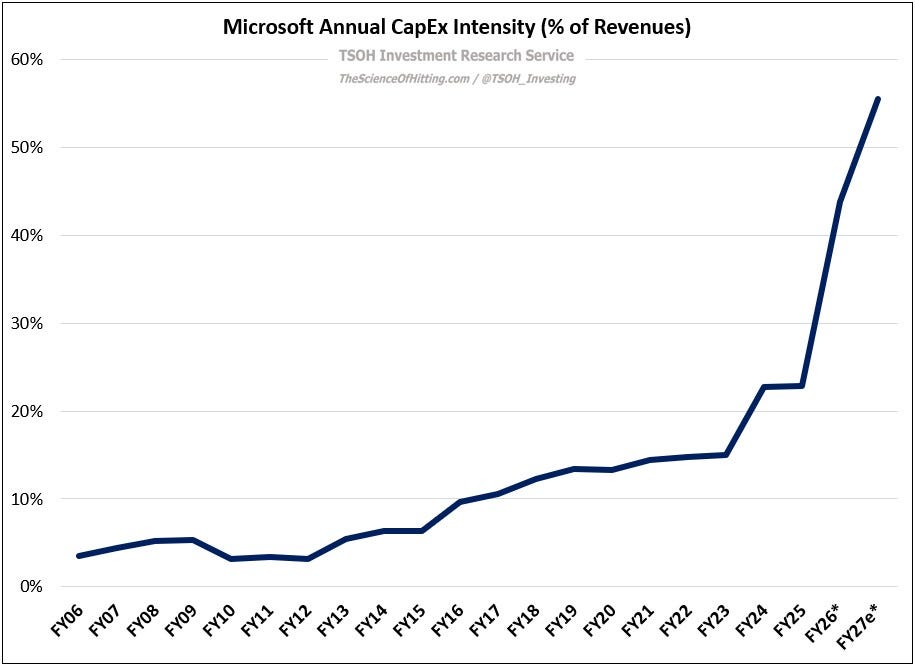
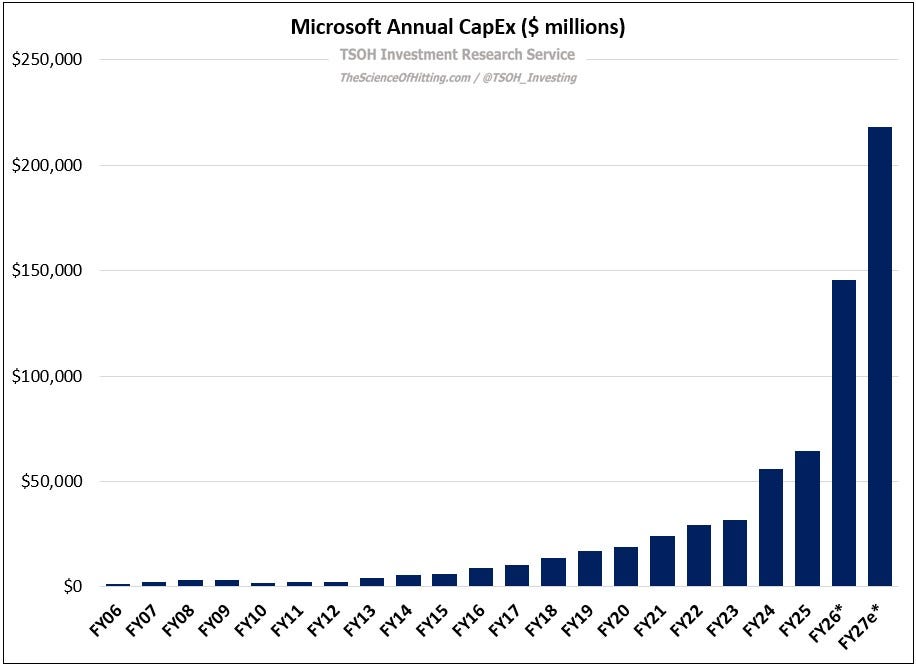
As shown below, Microsoft’s CapEx intensity throughout much of the past decade was in the 10% - 15% range. That changed significantly in the past two years, with CapEx intensity expected to exceed ~50% of revenues in FY27e. In dollars, the business went from annual CapEx outlays measured in tens of billions of dollars, to a number that may exceed $200 billion this year.
The challenge this presents is assessing the effectiveness of this massive investment (ROIIC); there’s a timing mismatch between the inputs and outputs, and there are evolving competitive dynamics between legacy mega cap tech companies and emerging competitors. Stated simply, there’s been a lot of uncertainty on how this was all likely to play out. That unease was evident in Microsoft’s stock price slide, which at recent lows was down more than 30% from the highs. Microsoft’s Q4 FY26 results, along with the call commentary, provided some needed reinforcement on their long-term strategy and the foundation underlying its competitive advantages.