

From “Vital Farms: Fragility” (March 2026):
“While this capacity expansion is necessary to reach their ~$2 billion FY30 revenue target, I think there’s a decent chance we’ll look back and conclude this wasn’t an opportune moment for a meaningful ramp in egg capacity and farmer supply, particularly if Vital Farms sees more price elasticity as they pursue volume growth outside of the core (i.e. a family who considers eggs from Costco, Trader Joe’s, or a local grocer a substitute at a large price gap).”
On May 7th, Vital Farms reported a disastrous first quarter, which included weaker than expected revenue growth and ~1,000 basis points of YoY gross margin compression. This softness is expected to hold at least throughout the remainder of the year, with management taking a hatchet to their revenue and profit guidance: on EBITDA, the business is now expected to roughly breakeven for the year, compared to prior expectations – set 90 days ago – for FY26e EBITDA of ~$110 million. (Their EBITDA guidance excludes roughly $30 million of D&A and stock-based compensation expense.)
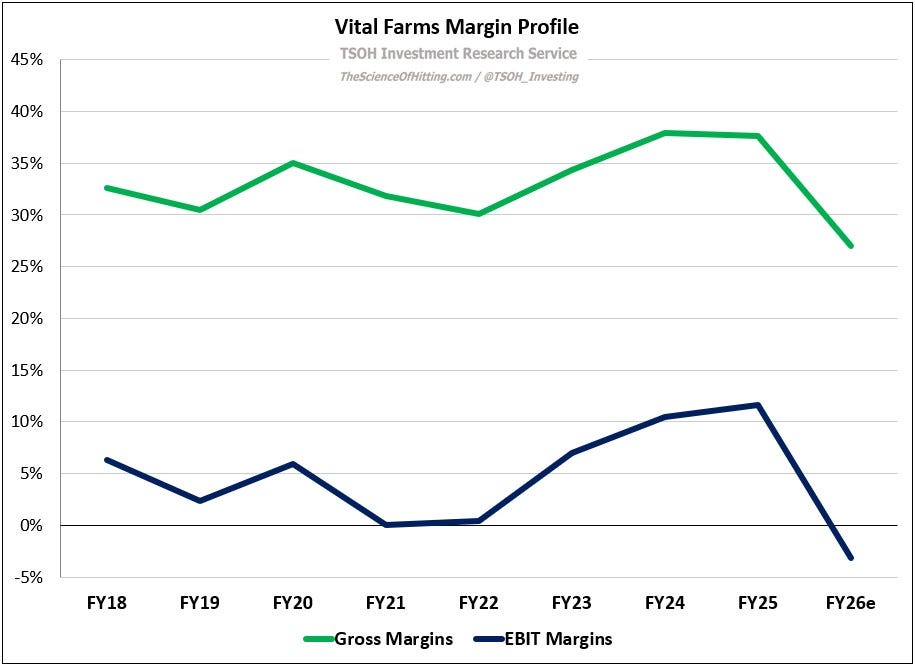
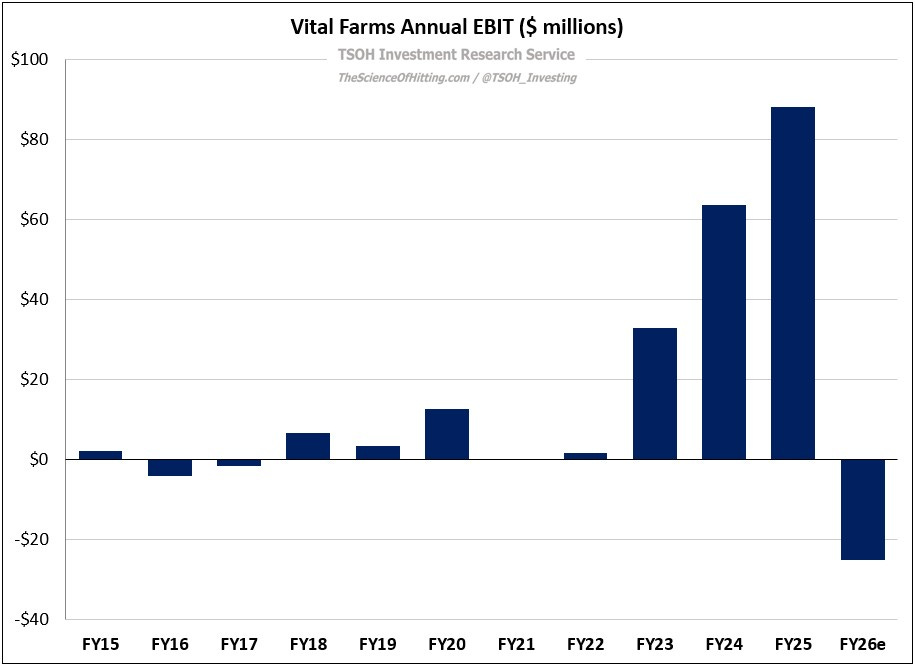
As explained by CEO Russell Diez-Canseco, the main concern that I focused on in “Fragility” – price competition in the subcategory – is heavily weighing on Vital Farms: “Our Q1 performance fell short of expectations, as anticipated changes in industry pricing and promotional dynamics in the outdoor access egg subcategory had a much greater impact on our velocities than we expected. We are acting with urgency to restore volume growth by narrowing price gaps versus other outdoor access eggs, which we believe will help reaccelerate our velocities. We are streamlining our cost structure and reducing CapEx this year to better align our operating model with the current environment… Price gaps reached levels our brand could not sustain.”
I am not surprised by cyclicality in the company’s results, a reality of supply / demand imbalances and commodity (egg) price volatility, a condition the subcategory isn’t immune to. At the same time, the duration and severity of exposure to commodity cyclicality gets at a critical question on management’s long-term strategy - and by extension, the quality of the underlying business.